Storytelling and emotional manipulation through music
Is it possible to consciously and strategically inflict certain emotions and feelings, using sound and music?
An experimment research by Rafaelos Christofi
Listen to all the pieces and complete their respective questionaries.
Agnese Valmaggia
Asli Emre
Domenico Napoli
Matthijs Van Der Wilt
Agamemnon Maziotis Vasileiou
Máximo Francisco
Mik van Boxtel
Rafaelos Christofi
Thank you!
If you are interested in the results of this research and you want to be updated of its progress, please subscribe by sending me an email!
Storytelling and emotional manipulation through music
Is it possible to consciously and strategically inflict certain emotions and feelings, using sound and music?
My name is Rafaelos Christofi, and I am a Cypriot classical composer, with focus on programmatic and interdisciplinary composition. What first inspired me to pursue composition was the way that music and movie/visual danced around and complemented each other creating context and a feeling between them that you would not get while either listening to the music alone or watching the movie without sound. I understood that in the case of the film industry, music could say, transmit and show something that the film or the story itself could not. It could subconsciously influence you to feel and physically react in a certain way depending on what you are watching at the moment, and in result shape your perception, feelings, understanding and opinions about a specific character or even the whole story. I understood later that personally, I am more of a storyteller, that can tell his stories through music.
Unlike most of my colleagues and friends I don’t have a lot of classical experience. For the better part of my childhood, I was having modern guitar classes. It wasn’t until 4 years before I joined Codarts that I started playing classical guitar and to learn a bit more about the classical world. After joining the classical performing and composing world I realized that the emotional connection with music was not as strong as I experienced in the past, and with time I was feeling it less and less. I felt that performers were not understanding or connecting emotionally with what they were playing, and that composers were more concerned about the intellectual part of composing rather the emotional one. Although I could see this for some time, the idea for this research was inspired by my own struggles to emotionally connect with my music and inflict the same emotions I intended to the audience that is listening to my music. I found it strange that I was taught music harmony, theory, history, rhythm, culture, notation, composition, instrumentation and even applied composition, but not one person ever mentioned anything to me about storytelling, dramaturgy, psychology and emotional triggering through music. I found it so strange that in an analysis class for example I would hear something like ‘’Here Ravel ends his theme differently than the previous time. Instead of a tonic chord he is using the sixth chord of the scale etc…’’ but never ‘’ ’Here Ravel ends his theme differently than the previous time. How does that make you feel? Do you think Ravel intended for you to feel in that way? If no, what could have been his intentions and how could he have done it better?’’. I realized that I had in my disposal so many books and experts about almost anything I could think of considering music, except the one think that I really needed, ways that I could be more emotionally invested in my compositions and ways that I could use to more strongly trigger the emotions I intended to the audience.
So, I decided to create a book, almost like a manual about emotional infliction and manipulation through music, a book that teaches you how to deeply connect emotionally with your music, how to understand what you are feeling and what you want other people to feel, techniques and strategies based on experts, history, culture and science on how to achieve that through composition, either that’s only music or interdisciplinary composition. This is obviously a huge topic, a dream that I want to pursue until the end in the upcoming years of my life, but my aspirations are to start here with a taste and use this research as a first experiment, then follow my research further to my master’s degree and then to PHD. In this bachelor’s research I intend to examine how a composition that is created based on a specific story can be most effective in transmitting the emotions, trajectory and essence of that story, enhance the impact that it makes and possibly add more context to it.
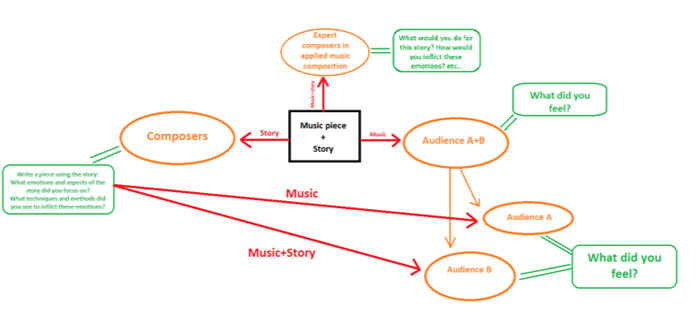
To achieve that I will start with a specific music piece that has a clear story and emotional trajectory. Then I will give the story of that piece, but not the music, to a small group of composers, for them to write pieces using that story, and the music but not the story to an audience group. While the composers are working on their pieces, I will be interviewing different expert composers in applied music composition about their own approach when it comes to inflicting certain emotions and working with a story. I will also ask them to tell me what their approach would be in creating a piece for this specific story, then ask them to react on my musical version and collect their comments and reactions. Later, the new pieces of music created by the group of composers will be exposed to two audience groups (the previous audience group split into two different groups) where one group listens only to the music, and the other one listens to the music after reading the story of the piece. After the listening session, I will collect the reactions of each audience member in detail and determine which techniques, pieces of music and decisions were proved to be most effective considering their intentions. Then those techniques, pieces of music and decisions will be cross referenced with the techniques and theories proposed by the expert composers in order to figure out what techniques work better with this specific story, which are more generalized and which techniques work best when the audience knows the story and which with only the music. The goal is to understand the mentality or mental paths that a composer needs to take in order to achieve his intentions when it comes to getting a certain emotion to the audience using music. The data collected will show how close did the composers get in inflicting the emotions they intended in the way they intended, and later I will collect the tools and techniques that were used for the improvement of my own practice. The reason that I am using other composers for this and not me, is because like this I can take a step back and observe the process with a colder and more objective mind.
All these actions will conclude to a very promising start in understanding how the mind works when it comes to consciously inflicting emotions through music, from the composer’s hand directly to the audience’s ears. Regarding my personal practice, I will understand how my piece could have been better and how to approach my next piece. I will get a better understanding on how to be more invested emotionally in my music and how to take more into consideration how a third party, either that’s the performers or the audience, will react on what I wrote. Did I succeed on my intentions?Furthermore, I will understand how the addition of another form of art can shape the understanding and the perception of the narrative and the emotional trajectory when it comes to storytelling. How does the body react psychophysiologically to certain sounds and pieces of music? How does timing, pitch, rhythm etc., affect the listener and how does it affect the story?All these questions are questions that are constantly in my head when I am composing, and the only way that I could answer some of them so far was experience, creativity, empathy and imagination. My goal is not to say that ‘’for the audience to feel fear, you need to do this specific thing’’. My goal is to better understand my listener and how to really connect with my music. If I really connect with it, then I will consciously make decisions to achieve my intentions. I do not believe that there is only one way to achieve a certain emotion through a certain story. But I believe that each direction refers to a combination of decisions that can succeed at inflicting a certain emotion, to a certain degree. Yes, you can achieve for example fear with many ways, but not all the directions will achieve the same type of fear, and one of these directions will not achieve the same type of fear in different contexts and musical or interdisciplinary settings. My goal is to gather enough knowledge so that when I am inspired to pick a direction, to make smart, creative and honest decisions that will lead to the success of my intentions in a large degree. This means a list of compositional techniques, directions, theories and processes of thought related to specific sensations.